


Close-up · resin at the packer
Resin coming out of the crack beside the packer. Move to the next one.
 Flood Test Balloon
$28.00
 ACTFLEX 400 CLEAR Over-Tile Leak Repair Coating
$66.00
 Innovative Tools 230mm FC Sheeting Puddle Flange Recess Kit
$504.00
 Soudal T-Rex Crystal
$17.85
 Puddle Pro 90mm Puddle Flange
$15.00
 BAT Spike Roller 21mm x 500mm
$55.00
 STAIN-PROOF Premium Impregnating Sealer by Dry-Treat
$79.95
 ACTFLEX 400 CLEAR Temporary Leak Repair Kit For Leaking Bathrooms & Balconies
$94.35
Cart
0Your cart is empty
Let's get your project sorted - start with a system below.

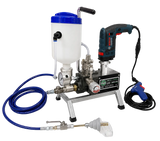
A compact drill-driven piston pump that injects ACTFLEX PU resin, acrylic gel and epoxy into concrete cracks at up to 300 bar. Stops active leaks in basements, lift pits, balconies and retaining walls from the inside, with no digging. 2.5 L tank, 5 m quick-connect hose and an auto-clean mode.
Find the leak, drill at 45°, set and tighten the packers, charge the SWM 1300, inject bottom up until the PU foams out, clean it, then pull the packers and patch. From the SWM 1300 manual and the ACTFLEX PU data sheets.
A live leak in a tank wall, sealed watertight.
Water running through the wall, packers in, ACTFLEX PU500 pumped in until it foams out of the crack. High pressure into a tight crack, one packer at a time: the work the SWM 1300 is built for.
Crack volume = length × width × depth. The PU data sheets give no fixed rate per metre: estimate from the crack volume plus an allowance for porous zones, then check it on the first section. Packers every 200 mm, the most the TDS allows.
Your resin and packers from the calculator are already in. Change any quantity, tick what else you need, and add it all at once. Machine showing Back soon? Call (02) 8021 3517 to order it.
The 1300 gives you machine pressure, up to 300 bar, in a compact 8 kg unit. Step up to the 1500 when you need more flow and a bigger hopper for whole basements.
| INJEXA SWM 1300Compact, high pressure | INJEXA SWM 1500More flow, bigger hopper | INJEXA SWDM 2500Two-part structural epoxy | |
|---|---|---|---|
| Job | Small to medium leaks | Active leaks, whole basements | Structural cracks, dry |
| Pressure | Up to 300 bar | 5–250 bar | 5–25 bar (ER300) |
| Flow | 0.6 L/min | 1.0 L/min | Metered A + B |
| Hopper | 2.5 L | 6 L | Twin tanks |
| Weight | 8 kg | 15.5 kg | – |
| Resin | PU, acrylic gel, epoxy | PU200 / 300 / 500 | ER300 epoxy |
| Price | $2,200 | $3,740 | $4,000 |
| View 1500 | View SWDM |
PU200 is a water-stop resin. It reacts with the water already in the crack and foams up to fill the leak path, so it needs water to work. Dry cracks get pre-wetted through the packers first.

Packer spacing, drilling angle and the resin path, drawn to the FORSPEC standard. Hand it to the builder or the engineer and the job is specified before you arrive.
How to stop your injection machine clogging.
In damp conditions resin starts to thicken while you work. Keep it moving, and flush the pump and hose properly at the end of every job.
Leaking ceilings and walls, done with INJEXA pumps and ACTFLEX resin. Tap to play, sound on.
Resin coming out of the crack beside the packer. Move to the next one.
Coupler on the packer and resin pushing out along the crack beside it. That's the leak path filling.
Injecting a ceiling crack from below. The non-return packers hold the resin in while it reacts.
Inside one of our crack injection courses. Which resin, where the packers go, and how to stop active water.
@jn.waterproofing · 13 Aug 2026 · View post


 For this machine
Hands-on resin injection: when to inject, which resin for which leak, where the packers go and how to stop active water. You leave with a certificate of completion.
 Best seller
A full bathroom, start to finish, on a real rig: moisture check, primer, bond breakers, membrane at the right thickness, flanges sealed. We show you, then you do it.


Once the leak is stopped, patch the holes. If the crack has to carry load, that's epoxy, not PU.
 FORBUILD 100Repair mortar the PU data sheets name for patching the packer holes$88In stock
 ACTFLEX HYDROPLUGHand-set leak stopper, sets in 2–4 minutes against running water$220In stock
 CRACKLOCK E400LUltra-low-viscosity epoxy for hairline cracks$110In stock
 INJEXA SWM 1500More flow and a 6 L hopper for whole basements. In stock$3,7403 in stock
Both inject ACTFLEX PU resin. The 1300 is lighter (8 kg) and goes to a higher peak pressure, 300 bar. The 1500 moves about 1.7 times the resin per minute and holds 6 L, so it suits whole basements and big car park jobs.
Set it to the resin: PU200 and PU300 at 80 to 150 bar, PU500 at 60 to 100 bar, epoxy at 100 to 200 bar. Never go past 300 bar. Pump each packer until resin shows about 100 mm either side, then move to the next.
PU200 for running water: it foams 8 to 20 times on contact with water. PU300 when you want to set the reaction time with the accelerator. PU500 for cracks and joints that move. For a structural repair of a dry crack, use ACTFLEX ER300 with the INJEXA SWDM 2500.
The PU data sheets don't give a fixed rate per metre. Work out the crack volume (length × width × depth), add an allowance for porous concrete, and check it on the first section. The calculator on this page does that for you.
Run the auto-clean mode with ACTFLEX FLUSH through the piston and hose, then 50 to 100 ml of clean engine oil for 30 seconds. Never use water: it corrodes the piston and voids the warranty.
Once the resin has fully reacted (24 hours at 25 °C), take the packers out and patch the holes flush with FORBUILD 100 repair mortar, as the PU data sheets say. If water is still running from a hole, stop it first with ACTFLEX HYDROPLUG.
Call our team on (02) 8021 3517. We'll give you the next delivery date, or move you to the SWM 1500, which is in stock.
Call our team on (02) 8021 3517 and tell us about the crack. We'll tell you the machine, resin and packers to use.
10 mm holes at no more than 200 mm along the crack, offset from it and angled at 45° so they cross it 60–100 mm in. Alternate sides where you can. Blow or vacuum every hole clean.
Push in a 10 mm non-return packer, leaving about 20 mm proud. Tighten it firmly with the T-handle so the rubber sleeve seals against injection pressure.
PU needs water to react. If the crack is dry, pump clean water through the packers first.
Never water in the pump. Fill the 2.5 L tank about two-thirds and fit the lid. Set the pressure to the resin: PU200 and PU300 80–150 bar, PU500 60–100 bar. Start the drill and press the auto-lock.
Build up slowly, never past 300 bar. Vertical cracks bottom up, horizontal ones from the ends to the middle. Pump each packer until resin shows about 100 mm either side, then move on. Don't over-inject.
Run auto-clean with ACTFLEX FLUSH, then 50–100 ml of engine oil. After full reaction (24 hours), remove the packers and patch the holes flush with FORBUILD 100.
From the INJEXA SWM 1300 manual and the ACTFLEX PU TDS R2. Times at 25 °C, 50% RH. Don't inject below 10 °C.
Machine values from the INJEXA SWM 1300 manual. Resin values from ACTFLEX PU TDS R2 (12 Aug 2026), typical at 25 °C and 50% RH.
Resin values are typical Forspec R&D characteristic values. More on request: (02) 8021 3517.
What applicators say
JN Waterproofing sealed a live leak in a tank wall with ACTFLEX PU500, and posted the job.
@jn.waterproofing · 28 Aug 2026 · See the postJN Waterproofing injected a run of ceiling cracks with ACTFLEX PU500, resin out at every packer.
@jn.waterproofing · 13 Aug 2026 · See the postNo verified reviews on the SWM 1300 yet. Own one? Tell us how it went and we'll add your review here.
Send us your review · or call (02) 8021 3517