


01

ACTFLEX 929 SL - Self-Levelling Polyurethane Waterproofing Membrane
Self-levelling one-component PU membrane for floors under screeds and tiles. Class III to two standards.
ACTFLEX 929 SL is a one-component, moisture-cured, self-levelling polyurethane waterproofing membrane. It flows to a flat, pinhole-free film on horizontal surfaces, and cures with atmospheric moisture. Priming is mandatory on every substrate.
Where to use it
- Internal wet areas: bathrooms, showers, laundries and kitchens (AS 3740:2021)
- External non-exposed areas: balconies, terraces, podiums and roofs beneath screeds, tiles or pavers
- Planter boxes and above-ground pits, positive side, with drainage protection
- Foundations, ground floors and suspended slabs, positive side
- Prime every substrate first: ACTFLEX 700 PU PRIMER, ACTFLEX EP250 or ACTFLEX SUPERBOND 007 depending on the substrate
Why waterproofers buy it
- Class III, high extensibility, all durability and cyclic-movement criteria pass
- One-component, no site mixing ratios, no induction time
- Self-levelling, flows to a flat, pinhole-free film on horizontal surfaces
- Tolerant of intermittent water immersion
- Accepts light foot traffic after full cure
- Recoat maximum window 48 hours; full cure 48 hours after the final coat
- 15 L pail (20 kg)
Coverage
15 L pail: 8 to 10 m² practical yield at 1.2 mm minimum DFT over two coats, using about 1.4 L/m² for the system.
Not for
Not UV stable, must be covered after curing or top-coated where exposure is unavoidable. Self-levelling grade, will slump on vertical surfaces, use ACTFLEX 929 HV for verticals and upstands. Not suitable for constant submersion such as pools and ponds, or chlorinated environments. Not a vapour barrier and will not resist negative-side hydrostatic pressure. Suitable for light maintenance foot traffic only, not daily pedestrian use.
Recoat and cure times at 25°C, 50% RH.
Certified Class III under both AS/NZS 4858 and AS 4654.1
Self-levelling - flows to a seamless, flat, pinhole-free film on horizontal surfaces
One-component - no site mixing ratios and no induction time
1
7-Day ReturnsMoney back
Fast DispatchNext business day
Expert Advice(02) 8021 3517
Secure CheckoutSSL encrypted
Accessories you might need
Technical overview
- ACTFLEX 929 SL is a one-component, moisture-cured, self-levelling polyurethane waterproofing membrane classified Class III (high extensibility) to AS/NZS 4858.
- It is designed for internal and external non-exposed applications beneath tiles, screeds, toppings and protection layers, and cures with atmospheric moisture to a seamless, fully bonded elastomeric film.
- It is certified Class III under both AS/NZS 4858:2004 (XTecGen Report 429-2) and AS 4654.1-2012 (XTecGen Report 429-3), tested by a laboratory accredited for compliance with ISO/IEC 17025, with cyclic movement, water immersion and heat ageing all passed.
- Priming is mandatory on all substrates.
- It is not UV stable and is not suitable for constant submersion.
Key applications
- Internal wet areas - bathrooms, showers, laundries and kitchens (AS 3740:2021)
- External non-exposed areas - balconies, terraces, podiums and roofs beneath screeds, tiles or pavers
- Planter boxes and above-ground pits (positive side, with drainage protection) - minimum 1.5 mm total DFT
- Foundations, ground floors and suspended slabs (positive side)
- Covered bridges, walkways, substations and parking decks beneath toppings
- Industrial and warehouse floors beneath protective toppings
- Remedial and maintenance waterproofing over approved substrates
Surface suitability
- Concrete (cured minimum 28 days, wood-trowel finish, CSP 2-4, primed)
- Renders and screeds (cured minimum 7 days, wood-trowel finish, sound and non-friable, primed)
- Fibre cement sheet walls (minimum 6 mm, wet-area grade only, fixed to manufacturer's specification)
- Compressed fibre cement floors (minimum 15 mm, wet-area grade only)
- Brickwork, blockwork and masonry (sound, primed with ACTFLEX 700 PU PRIMER)
- Timber (structural wet-area approved, rigid, fixed at 400 mm centres maximum, primed)
- Metal and PVC (abraded, cleaned and primed with ACTFLEX SUPERBOND 007)
Not UV stable - must be covered after curing, or top-coated with ACTFLEX ATC or ACTFLEX ULTRA TC where exposure is unavoidable. Self-levelling grade - will slump on vertical surfaces; use ACTFLEX 929 HV for verticals and upstands. Will flow towards falls and drains - plug drains before application. Direct tile adhesion to the cured membrane is not recommended - install over a screed. Not compatible with silicone or bituminous surfaces or products. Not suitable for constant submersion (swimming pools, ponds) or chlorinated environments. Not a vapour barrier and will not resist negative-side hydrostatic pressure. Apply to dry substrates only, do not apply below 10C substrate temperature or within 3C of the dew point, and do not apply if rain is expected before the film is tack free. Do not exceed 1.5 mm wet film thickness in a single coat. Movement joints must be detailed separately. Suitable for light maintenance foot traffic only, not daily pedestrian use, sharp footwear or machinery. Limited root resistance - aggressive or deep-rooted species require a dedicated root barrier.
Shipping and returns
Dispatched same or next business day from Roselands NSW, with fast delivery Australia wide. 7-day returns on unused stock in original packaging (20% restocking fee).
Why waterproofers use ACTFLEX 929 SL
02
Self-levelling - flows to a seamless, flat, pinhole-free film on horizontal surfaces
03
One-component - no site mixing ratios and no induction time
How to apply ACTFLEX 929 SL
Step by step from the technical data sheet. Always read the full TDS before you start.
-
1
Confirm every substrate is installed to the relevant Australian Standard, is structurally sound and is within its manufacturer's tolerances before waterproofing begins
-
2
Prepare mechanically and vacuum-clean, removing laitance, oils, grease, wax, mould, dust, curing compounds, release agents, existing coatings, adhesives, loose particles, rust, paint and efflorescence
-
3
Reinstate damaged and spalled concrete with FORBUILD 100 or FORCRETE 100 and allow all repairs to cure before priming
-
4
Grind off high points, fins and protrusions, then fill blowholes, honeycombing and surface imperfections flush with a high-strength non-shrink repair mortar
-
5
Verify falls before waterproofing - internal wet areas minimum 1:80, external areas minimum 1:100, draining positively to outlets with no ponding
-
6
Treat static cracks less than 2.0 mm with ACTFLEX SA TAPE over a primed 200 mm band and encapsulate the tape with two coats of ACTFLEX 929 SL
-
7
Treat static cracks 2.0 mm and greater by chasing a reglet minimum 6 mm wide and 6 mm deep, filling with ACTFLEX 75FC, covering with a bond-breaker tape and applying two coats once the sealant has skinned
-
8
Rectify structural and live cracks with PROBOND 1100, CRACK PRO 1200PS or CRACKLOCK E400L before any waterproofing proceeds
-
9
Prime every substrate - ACTFLEX 700 PU PRIMER on porous dry substrates, a minimum of two coats of ACTFLEX EP250 on damp or high-moisture substrates, ACTFLEX SUPERBOND 007 on non-porous substrates
-
10
Apply the membrane within 24 hours of priming to avoid intercoat contamination, and re-prime any surface that exceeds its overcoat window
-
11
Detail all floor/wall and wall/wall junctions, penetrations, drains, fixings and changes of substrate with ACTFLEX SA TAPE lapped a minimum of 50 mm, or with an ACTFLEX 75FC fillet - 12 mm diagonal internally, 15 mm x 15 mm externally
-
12
Cut out and discard any surface skin, then mix with an electric drill and paddle mixer at low speed, 300 to 500 RPM, for 2 to 3 minutes until uniform and lump-free
-
13
Pour and spread the first coat by squeegee or roller at 0.7 mm wet film thickness and back-roll to a uniform pinhole-free film, checking with a wet film gauge and maintaining a wet edge
-
14
Recoat after a minimum of 24 hours and a maximum of 48 hours at 25C and 50% RH, to a total 1.2 mm minimum dry film thickness
-
15
In planter boxes apply both coats at approx. 0.85 mm wet film thickness to a total 1.5 mm minimum dry film thickness, allowing additional cure time at the heavier build
-
16
Allow 48 hours full cure after the final coat before flood testing, tiling, screeding, backfilling or covering
-
17
Flood test to a minimum depth of 50 mm at the highest point of the membrane and hold the water for 24 hours, inspecting the underside and perimeter for leakage
-
18
Install a 200-micron polyethylene slip sheet and an unbonded screed minimum 40 mm thick reinforced to AS 3958.1, then fix tiles to the screed - do not tile directly to the membrane
-
19
In landscaped and below-fill areas cover the cured membrane with HIFLOW drainage cell and filter fabric before placing fill, ballast or pebbles
Specifications
Every figure from the technical data sheet, in one table.
Property
Value
Membrane Classification
Class III (high extensibility), AS/NZS 4858 and AS 4654.1
Solids Content
90% +/- 2%
Viscosity
3,000-5,000 mPa.s at 25C*
Chemical Base
One-component moisture-cured polyurethane
Curing Mechanism
Moisture-cured (atmospheric humidity)
Colour
Grey, viscous self-levelling liquid
Packaging
15 L pail (20 kg)
Tensile Strength
5.11 MPa (AS/NZS 4858, Report 429-2); 4.09 MPa (AS 4654.1, Report 429-3)
Elongation at Break
477% (AS/NZS 4858, Report 429-2); 756% (AS 4654.1, Report 429-3)
Cyclic Movement
Pass, no failures - both standards
Durability, Water Immersion
Pass, 673% / 2.55 MPa retained (AS 4654.1 App. A)
Durability, Heat Ageing
Pass, 739% / 4.50 MPa retained (AS 4654.1 App. A)
Water Absorption
0.82% (AS 3558.1, modified sample)
Moisture Vapour Transmission
4.88 g/m2/24 h (ASTM E96 desiccant)
Adhesion to Primed Concrete
Greater than 1.5 MPa, concrete failure (ASTM D4541 pull-off)*
Shore A Hardness
55
Density
1.1-1.3 g/cm3
VOC Content
Less than 140 g/L*
Flash Point
Approx. 30C, combustible liquid (refer SDS)
Service Temperature (cured membrane)
-15C to +80C*
Application Temperature
10-30C; substrate minimum 3C above dew point
Application Humidity
40-85% RH ambient; no condensation present or imminent
Wet-Edge Working Time
Approx. 20-30 minutes at 25C, 50% RH*
Surface Skin Time
Approx. 2-4 hours at 25C, 50% RH*
Maximum Wet Film Thickness per Coat
1.5 mm
Recommended Thickness
1.2 mm minimum DFT over 2 coats, 0.7 mm WFT per coat
Planter Boxes
1.5 mm minimum DFT over 2 coats, approx. 0.85 mm WFT per coat; allow additional cure time and confirm full cure before flood testing
Consumption
0.7 L/m2 per coat; approx. 1.4 L/m2 for the two-coat system
Consumption, Planter Boxes
Approx. 1.7 L/m2 at 1.5 mm DFT - theoretical yield approx. 8.8 m2 per 15 L pail
Coverage
15 L pail approx. 8-10 m2 practical yield at 1.2 mm DFT
Tack Free Time
12 hours in a ventilated area at 25C, 50% RH
Recoat Time
Minimum 24 hours, maximum 48 hours at 25C, 50% RH
Full Cure
48 hours after the final coat at 25C, 50% RH
Light Maintenance Foot Traffic
48 hours after the final coat at 25C, 50% RH
Flood Test
After full cure, 24-hour test duration
Shelf Life
12 months, unopened, stored at 10-22C
* Typical characteristic values determined by Forspec R&D on standard production material; not subject to third-party certification
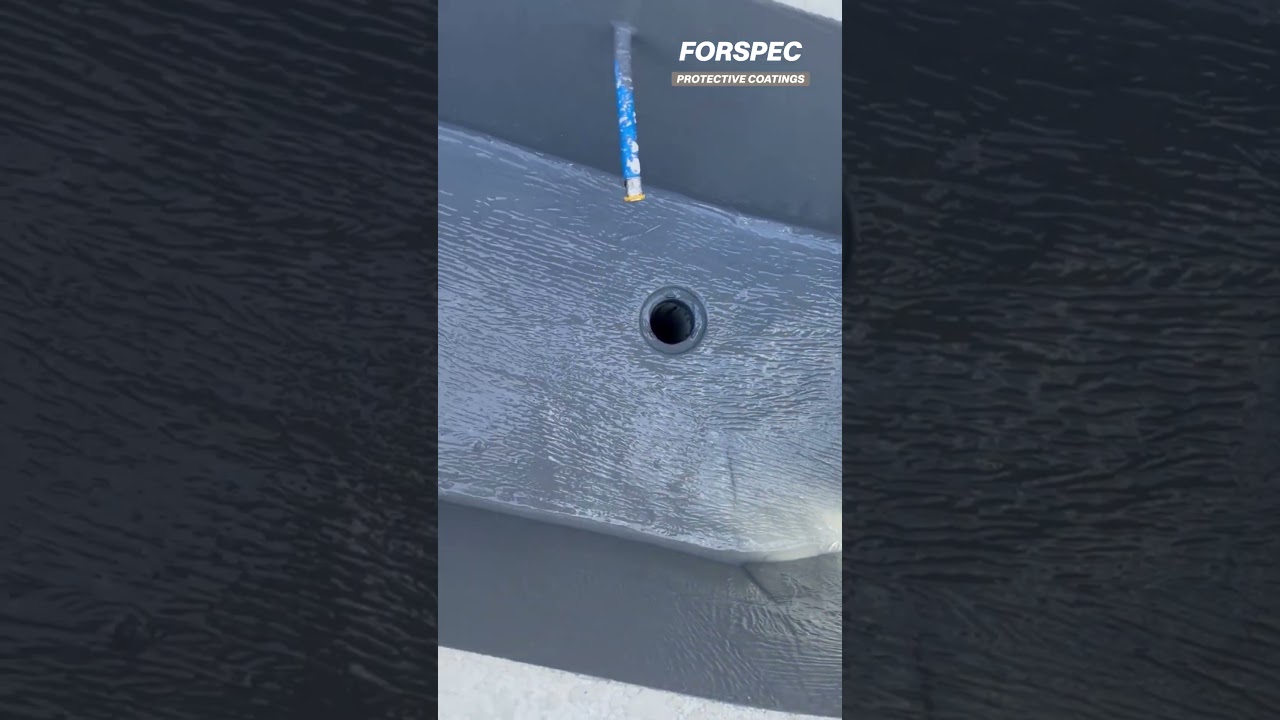
Watch the install
See how it goes on, step by step. Always read the full TDS before you start.
Customer reviews
Common questions
-
What is 929 SL and how is it different from 929 HV?
929 SL (Self-Levelling) flows out to a smooth seamless finish on horizontal surfaces. 929 HV (High Viscosity) stays put on verticals. Both are single-component moisture-cured polyurethane membranes - use SL on floors, HV on walls and upstands.
-
What's the elongation rating?
929 SL achieves a remarkable 750% elongation at break with tensile strength of 4.09 MPa. The high flexibility accommodates substrate movement and minor cracking without rupture.
-
How is it applied?
Pour the product onto the substrate and let it self-level. Spread with a notched squeegee if needed for uniform thickness. 8-10 m² per 20kg pail at 1.2mm DFT. Application temperature 10-30°C.
-
Where is 929 SL ideal?
Ideal for horizontal floor applications where seamless finish matters: large planter floors, plant rooms, wet area floors needing smooth substrate before tiling, and any flat surface where roller marks are unacceptable.
-
Standards compliance?
Class III waterproofing membrane. Root-resistant cured film makes it suitable for planter boxes and green roofs alongside the standard 929 HV system. Tack-free 12hr, recoat 24-48hr, full cure 48hr.
Ready to order?
1
Dispatched same or next business day from Roselands NSW. Questions? Call the team on (02) 8021 3517.